

Press Release
Hyundai E&C Deploys Wearable Robots, Caring for Worker Health
■ Supports stable overhead ceiling work by having workers wear the “X-ble Shoulder” for interior carpentry at The H Claest
■ Reduces fatigue from repetitive tasks through non-powered muscle-assist technology and free joint movement, while improving ease of use on-site
■ Will foster a people-centered smart construction environment by identifying site-tailored AI and robotics technologies
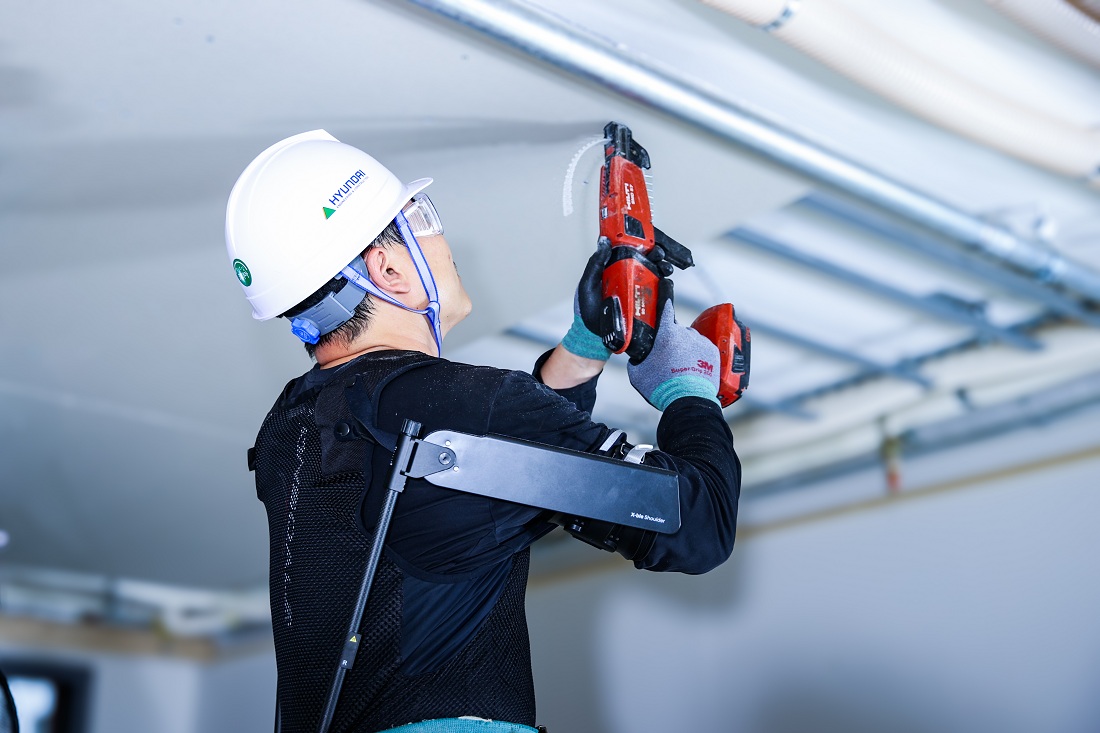
Image of an On-Site Worker Performing Ceiling Work While Wearing the "X-ble Shoulder" at a Construction Site
Hyundai E&C is introducing industrial wearable robots designed to reduce workers’ physical strain at construction sites as part of its efforts to create a people-centered work environment.
Hyundai E&C announced on Wednesday the 29th that it had become the first company in the construction industry to deploy the “X-ble Shoulder,” an industrial wearable robot developed by Hyundai Motor and Kia’s Robotics LAB, for interior carpentry work at The H Claest construction site in Seocho-gu, Seoul.
Ceiling work in interior carpentry involves workers repeatedly installing and securing materials while keeping their arms raised above their heads for extended periods. Due to the nature of the work, this places continuous strain on the shoulders and arms, and accumulated fatigue can affect both concentration and postural stability.
Hyundai E&C is utilizing the X-ble Shoulder in ceiling work to reduce the strain on workers’ shoulders and arms and help them maintain a stable working posture. This is expected to alleviate fatigue caused by repetitive tasks, thereby increasing concentration, while also helping to reduce the risk of musculoskeletal disorders and improve work efficiency. Going forward, the company plans to expand the scope of application by exploring its use in various processes that involve a significant amount of overhead work, such as upper-level equipment installation, ceiling painting, and wallpapering.
The X-ble Shoulder, developed in-house by Hyundai Motor and Kia’s Robotics LAB, is an industrial wearable robot designed to support workers’ upper-arm strength when performing tasks with their arms raised. Featuring a non-powered torque-generating structure, the device is lightweight and requires no separate charging, making it easy to maintain and manage. It also uses a muscle compensation module to generate assistive force, reducing the load on the wearer’s shoulder joints and the activity of the anterior and lateral deltoid muscles by up to 60% and 30%, respectively.
*Non-powered Torque Generation Structure: A method of generating force to assist arm movement through a mechanical structure, without a separate power source such as a motor or battery
**Muscle Compensation Module: A mechanical device that transfers the elastic energy of a spring as rotational force (torque) to assist the force needed when lifting the arm
Notably, the device supports a shoulder joint range of motion from 0 to 180 degrees, allowing wearers to move both arms freely while using it. As it does not restrict movement when workers lower their arms or sit down to rest, it is designed for use across a wide range of work environments.
A worker who used the X-ble Shoulder on-site said, “Normally, when I have to keep my arms raised for extended periods, fatigue builds up quickly in my shoulders and arms. With the X-ble Shoulder, however, it takes less effort to keep my arms raised.” The worker added, “It is convenient to use on-site because I can wear it without significantly altering my existing work methods or movements.”
Meanwhile, the HMG Construction Technology Research Institute, the integrated R&D organization of Hyundai E&C and Hyundai Engineering, operates dedicated AI and robotics research units, including the Smart Construction Research Lab, Robotics Research Team, and AI Research Team. Building on this foundation, the institute is focusing on expanding smart construction technologies, deploying robotics at construction sites, and enhancing safety, quality, and human-error prevention. By applying a range of smart technologies at construction sites, including ground-controlled tower cranes, autonomous nighttime material-transport robots, the quadruped patrol robot “Spot,” and unmanned drone stations, the company is strengthening worker safety management and improving operational efficiency. In addition, by integrating Hyundai Motor Group’s robotics and mobility capabilities, the Korean builder is actively pursuing innovation in future residential ecosystems that support every aspect of residents’ lives, including mobility, safety, and convenience.
