

Latest News
- Hyundai E&C Expands Footprint in Global Housing Development Market
- Hyundai E&C to Complete Korea's First AI Data Center in 16 Months
- Hyundai E&C, Seoul National University Hospital, and Seoul National University Jointly Develop AI-Based Next-Generation Healthcare Residential Services
- Hyundai E&C Sets Out to Secure Core Technology for Next-Generation Hydrogen Production via Water Electrolysis
- Hyundai E&C to Build a Future Mobility Safety Framework for Residential Complexes
Hyundai E&C to Complete Korea`s First AI Data Center in 16 Months
Pohang AI Data Center Enters Fast-Track Construction via PC Method
■ Hyundai E&C to Finalize 40 MW “Pohang AI Data Center” in November 2027… Innovating Both Quality and Speed
… AI-specialized high-performance data center featuring NVIDIA GPU-based systems, liquid cooling, and enhanced energy efficiency
… Demonstrating ultra-fast construction capabilities through the application of the PC method, Preconstruction Services (PCS), and fast-track delivery
■ Hyundai E&C Strengthens Its Leadership in the AI Infrastructure Market with an Unmatched Track Record and Breakthrough Technologies
… The largest number of AI projects completed in Korea‧Korea’s first AI data center ‧ Only Korean company with project experience for global big tech companies
… Advancing total solutions to build an AI ecosystem “from power generation to data centers”
Hyundai E&C kicks off construction of Korea's first AI-dedicated data center, accelerating its efforts to secure a leading position in the core AI infrastructure market.
Hyundai E&C announced on the 21st that it had recently finalized the main contract for the construction of the “Pohang AI Data Center,” commissioned by AI Factory Pohang PFV, and commenced installation of precast concrete (hereinafter “PC”) components.
The Pohang AI Data Center project involves the construction of a dedicated AI data center with a 40 MW power receiving capacity* and a 32 MW IT load* at the Gwangmyeong General Industrial Complex in Ocheon-eup, Nam-gu, Pohang, North Gyeongsang Province. Unlike conventional data centers designed primarily for general-purpose computing, the facility will be a GPU-based high-performance data center optimized for AI workloads that require real-time analysis and processing of large volumes of data. Construction began in June, with operations targeted to commence in the second half of 2027. The total construction period is 16.5 months.
*Power Receiving Capacity: The maximum amount of power that can be supplied from the external power grid. The Pohang AI Data Center’s 40 MW capacity is equivalent to the amount of electricity consumed simultaneously by approximately 130,000 or more households, based on the average household electricity consumption (214.78 kWh/month) in Nam-gu, Pohang.
*IT Load: The power consumed by servers and network equipment within a data center to perform their core IT functions.
The project developer, Neo AI Cloud, plans to build the Pohang AI Data Center as a scalable infrastructure capable of stably accommodating next-generation GPUs. The company envisions supporting both domestic and international enterprises from AI model development to service operation by integrating future GPU-as-a-Service (GPUaaS)* and AI platform services.
*GPUaaS (GPU-as-a-Service): A service that allows users to rent high-performance GPU hardware through the cloud on an as-needed basis without having to purchase it directly.
The Pohang AI Data Center is a project that brings together Hyundai E&C’s advanced technological capabilities, backed by its track record of constructing the largest number of data centers in Korea. To support GPU servers based on NVIDIA’s latest AI chip, “Vera Rubin,” the facility is designed with an ultra-high-density environment featuring approximately 10 times the power density of conventional cloud data centers. It will also introduce Korea’s first liquid cooling system* to address the cooling requirements of high-heat-generating AI servers. The facility is designed to achieve a Power Usage Effectiveness (PUE) of 1.25, minimizing energy loss and delivering one of the highest levels of power efficiency in Korea.
*Liquid Cooling System: Unlike conventional air-cooling systems, which use airflow to cool equipment, this method uses a liquid with high thermal transfer efficiency to dissipate heat better.
Another notable feature is the short construction period for this high-performance AI data center. To meet the tight 16.5-month construction schedule, Hyundai E&C fully adopted the precast concrete (PC) method. While there have previously been cases in Korea where certain components, such as beams and columns, were prefabricated for commercial data centers, this is the first time that the entire concrete structure (including slabs, walls, and staircases) has been prefabricated and installed. As a result, the structural work, which would have taken about a year using conventional cast-in-place methods, has been dramatically shortened to just two months, while safety and quality are also expected to be maximized.
In addition, Hyundai E&C shortened the overall project schedule by utilizing Pre-construction Services (PCS), which involve reviewing the optimal project structure and execution approach even before groundbreaking, along with a fast-track approach that advances design, permits & approval, and construction preparations simultaneously. As a result, the Pohang AI Data Center achieved the rare feat of breaking ground just about one month after Hyundai E&C joined the project.
A Hyundai E&C official said, “With the recent proliferation of generative AI and hyperscale AI models, competition in the data center market is shifting beyond sheer scale to a race to launch services, known as ‘Time-to-Market (TTM),’” adding, “Hyundai E&C will successfully complete the Pohang AI Data Center within the scheduled construction period, demonstrating its differentiated competitive edge by simultaneously securing Korea’s top-tier construction capabilities, business performance, schedule, and quality.”
Meanwhile, since constructing the Korea Financial Telecommunications & Clearings Institute’s Bundang Center in 2004, Hyundai E&C has built 19 data centers, the largest number among Korean construction companies, including the KT Mokdong IDC, Yongin Pacific Sunny Data Center, and NAVER Data Center “GAK Sejong.” The company has also demonstrated global-level technological capabilities and expertise as the only Korean construction company to have built a data center for a big global tech player.
Hyundai E&C plans to leverage its strengths in the energy sector to develop data center models that integrate renewable energy and small modular reactors (SMRs), tailored to the characteristics of local energy sources. By providing differentiated, comprehensive solutions across the entire energy value chain, the company aims to simultaneously build core infrastructure for the AI era and drive energy innovation.
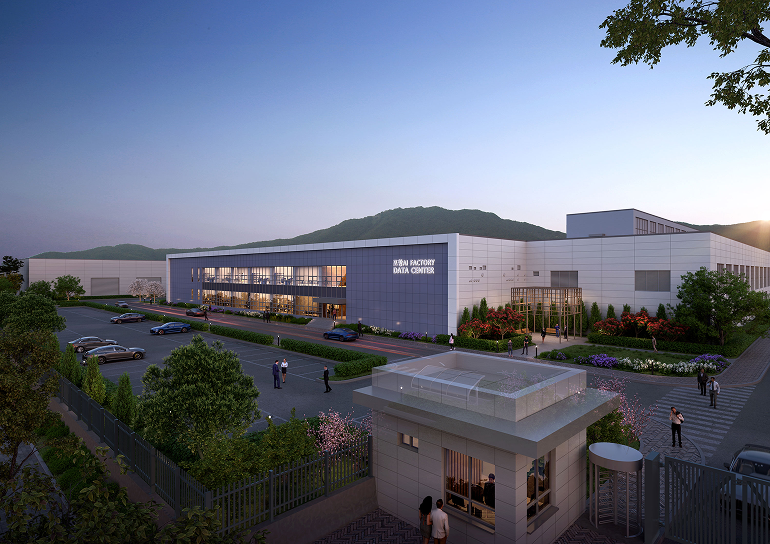
[Rendering of the Pohang AI Data Center, to be constructed by Hyundai E&C]
Join Hyundai E&C newsletter.
Hyundai E&C Newsletter
Meet the various stories from Hyundai E&C Newsletter every month.
Subscribe to Hyundai E&C newsletter and get the latest news via e-mail.
- Name
-
-
@
- Part
-
- country
-
Privacy Policy
We may collect the personal information for the following purposes.
- Information
- Name, E-mail, and Part
- Subject
- Apply and Discribe for the Newsletter, Deliver Newsletter
- Period
- Your personal information will deleted in 5days of work day.
- Name
-
-
@

Registration Number 101-81-16293, 03058 Hyundai Bldg., 75, Yulgok-ro, Jongno-gu, Seoul
© HYUNDAI E&C. ALL RIGHTS RESERVED.