

Latest News
- Hyundai E&C Expands Footprint in Global Housing Development Market
- Hyundai E&C to Complete Korea's First AI Data Center in 16 Months
- Hyundai E&C, Seoul National University Hospital, and Seoul National University Jointly Develop AI-Based Next-Generation Healthcare Residential Services
- Hyundai E&C Sets Out to Secure Core Technology for Next-Generation Hydrogen Production via Water Electrolysis
- Hyundai E&C to Build a Future Mobility Safety Framework for Residential Complexes
[H Highlight] A New Milestone for Korean Offshore Wind Power: The Hyundai E&C Offshore Wind Report
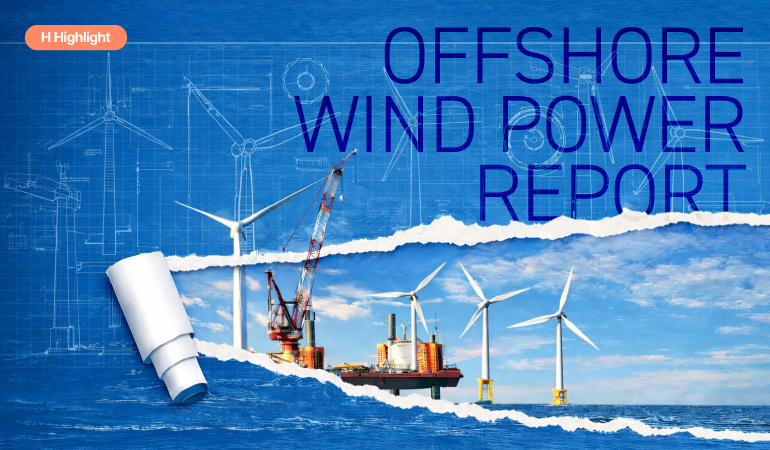
In the age of carbon neutrality, the sea has transformed into a land of opportunity—a vast reservoir of inexhaustible energy. Yet converting that wind into electricity while braving rough waves and complex underwater terrain demands a level of technological mastery and experience that few can claim. Hyundai E&C has been at the forefront of answering that challenge: from the Southwest Sea Offshore Wind Farm, Korea's first offshore wind demonstration site, to the Jeju Hallim Offshore Wind Farm, the country's largest commercially operating offshore wind complex. Now, poised to make a quantum leap onto the global stage through the Sinan-Ui Offshore Wind Farm mega project, what is the source of Hyundai E&C's enduring strength?
Part 01. Market
Finding Answers on the High Seas in an Era of Energy Transition
The twin imperatives of carbon neutrality and exponentially surging power demand are shaking the energy industry's paradigm to its very roots. The search for cleaner, more reliable energy is now inevitably turning from land to the open expanse of the ocean. The International Energy Agency (IEA) projects that renewable energy will account for a substantial share of future growth in electricity demand, with offshore wind power drawing particular attention as a generation method capable of producing power at scale.
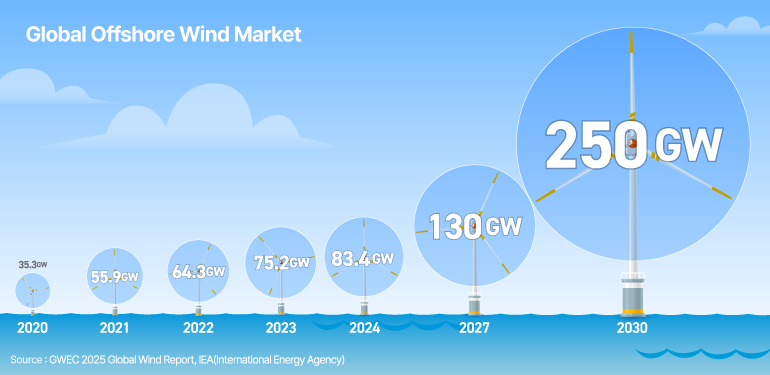
The global offshore wind market is expanding at a rapid clip. According to the Global Wind Energy Council (GWEC) and the IEA, cumulative installed capacity worldwide surpassed approximately 83 GW by the end of 2024. But that is only the beginning. If current growth trajectories hold, cumulative capacity is projected to reach 250 GW—more than triple today's figures.
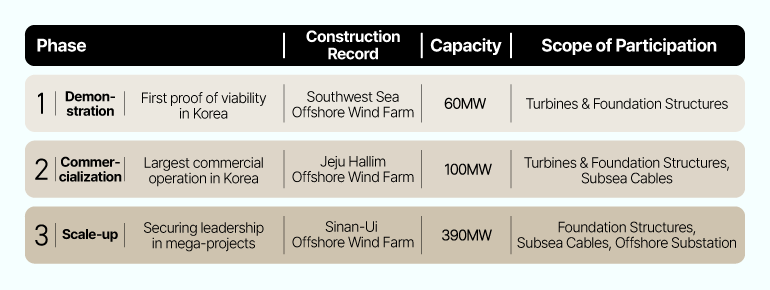
Korea's domestic offshore wind market has swiftly moved beyond the 60 MW-class demonstration phase and into commercial operation at the 100 MW-plus scale, with the industry now entering a phase of gigawatt-level expansion. Hyundai E&C has been a major player since the very beginning of Korean offshore wind, continually proving what is technologically possible. The Southwest Sea Offshore Wind Farm Demonstration Complex, where Korea's first offshore wind trials were conducted, and Jeju Hallim Offshore Wind Farm, which set a new standard for commercial operation at the largest scale in the country, were more than mere construction milestones—they were the solid foundation upon which the entire Korean offshore wind industry has been built.
The unparalleled experience and data accumulated through these projects are now serving as the powerful engine that drives a KRW 12 trillion pipeline, set to go into full swing starting with the Sinan-Ui project. Hyundai E&C is no longer is the company simply Korea's leading EPC contractor, but a global energy developer primed to expand the frontiers of Korean offshore wind power—taking full responsibility from project inception through to long-term operation.
Part 02. Performance
01. Southwest Sea Offshore Wind Farm
The Dawn of Korean Offshore Wind: A Pioneer That Set the Standard
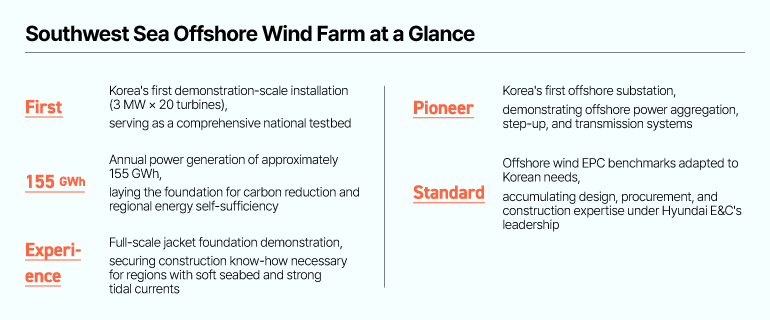
The Southwest Sea Offshore Wind Farm Demonstration Complex is a landmark project that elevated Korea's offshore wind industry beyond mere experimentation and established a national standard for full-scale commercialization. It stands as Korea's first project to demonstrate the entire process—structural design, construction, and grid integration in an actual offshore environment—before the country's leap into large-scale commercial operations. Successfully completed in 2020, the complex confirmed the reliability of Korean technology in a real-world setting, becoming a robust technological foundation that laid the groundwork for all subsequent Korean offshore wind developments.
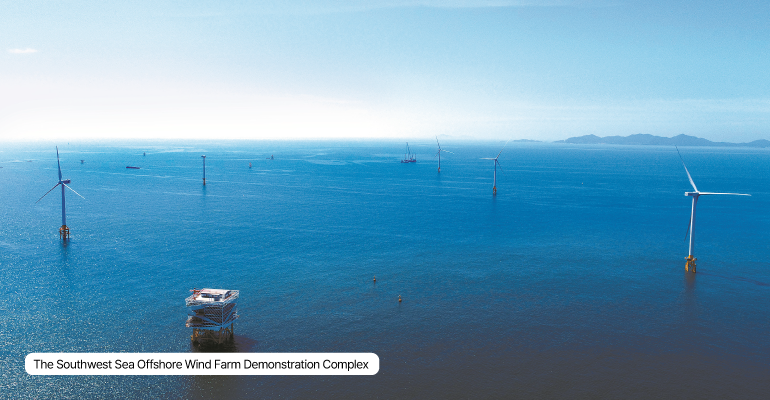
Its most significant achievement was the construction of Korea's first offshore substation. An offshore substation is a critical piece of infrastructure: it aggregates power generated at sea, steps it up to high voltage, and transmits it to the onshore grid via subsea cables. Through the Southwest Sea Demonstration Complex, Hyundai E&C gained firsthand experience building an offshore substation suited to Korean maritime conditions and established a benchmark for grid configuration that would support the future proliferation of large-scale offshore wind farms.
Equally notable was the acquisition of large-scale jacket-type foundation installation data in an extreme marine environment defined by soft seabed and powerful tidal currents. By managing every stage—from design and fabrication to transportation and installation—and verifying structural integrity throughout, the project directly translated into design standards and construction know-how for substructures adapted to Korea's unique offshore environment.
The field-tested technical standards and data accumulated from the Southwest Sea Demonstration Complex now flow directly into the Jeju Hallim and Sinan-Ui projects, forming the bedrock of the Korean offshore wind EPC model.
02. Jeju Hallim Offshore Wind Farm
Beyond the First Demonstration towards Largest-scale Commercial Operation
Jeju Hallim Offshore Wind Farm is more than a project that simply grew larger in scale—it is a testament to sheer determination, a triumph of Hyundai E&C's construction expertise in the face of Jeju's unforgiving marine conditions. Having commenced full commercial operations in 2025, this site now stands as the largest operating offshore wind farm in the nation (100 MW), supplying approximately 4% of Jeju Island's total electricity consumption as a core energy source.
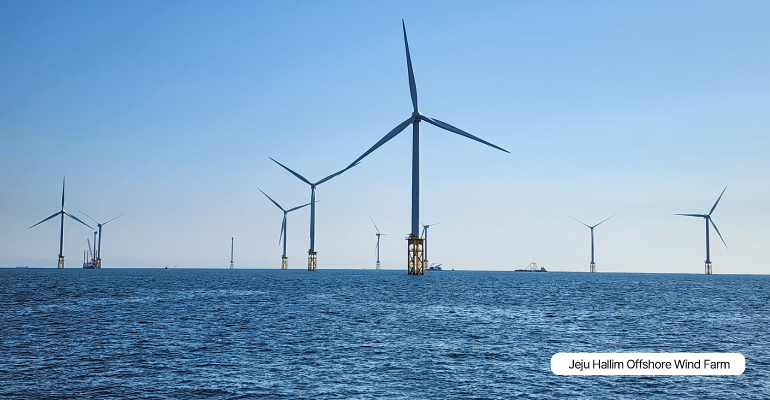
Yet behind this serene vista lay a relentless series of challenges. The seafloor around Jeju is composed of hard, irregular basalt bedrock, making it nearly impossible to sink a single foundation pile using conventional construction methods. To overcome this, Hyundai E&C deployed an advanced pre-drilling technique that involves precisely boring into the bedrock before seating the foundation. The precision required to drill through bedrock on the open sea amidst rough waves and erect structures with zero deviation was a masterclass in engineering, showcasing the full depth of Hyundai E&C's capabilities.
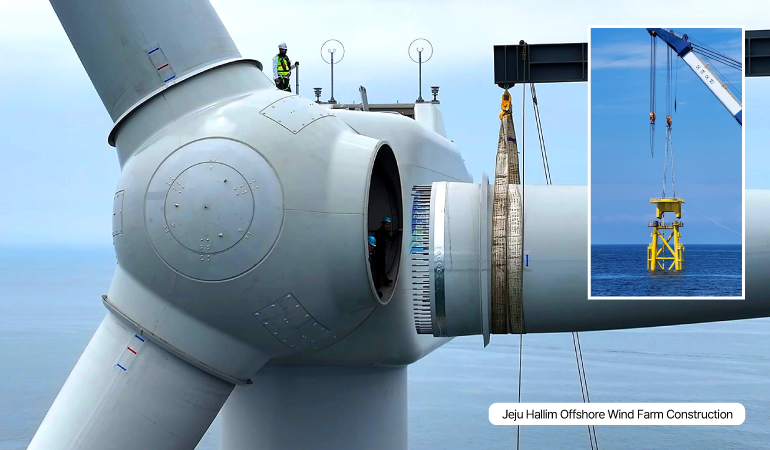
Laying the subsea cables posed an equally formidable challenge. To prevent the cables from snapping or sustaining damage amid complex underwater topography and swift currents, a specialized method was applied: arranging the cables in a flexible omega (Ω) configuration to distribute tensile forces. After this hard-fought completion, the Jeju Hallim Offshore Wind Farm now generates approximately 234 GWh of clean energy annually. As a global energy developer responsible for operating this vast complex for more than 20 years—well beyond the construction phase—Hyundai E&C has transformed the waters of Jeju into a foundation for a sustainable future.
.png "Jeju Hallim Offshore Wind Farm at a Glance")
Part 03. Solution
01. Core Solutions Adopted in Korea for the First Time
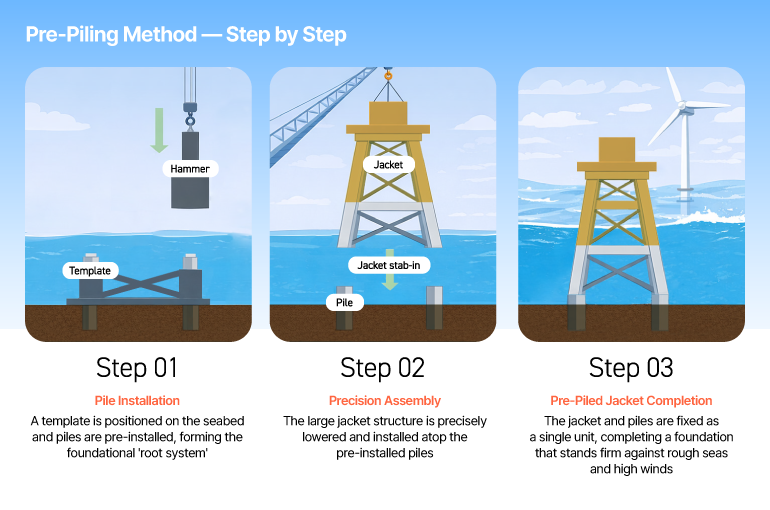
The Jacket Pre-Piling Method
As offshore wind farms grow in scale, the load on foundation structures increases, and the impact of installation tolerances on structural integrity and turbine performance becomes more pronounced. The pre-piling method uses piles as reference points during construction, enabling precise installation even amid shifting seabed conditions and variable marine environments. Before the jacket structure is erected, a template—a positioning frame used to pinpoint exactly where piles will be driven into the seabed—is installed first. Following the template's guides, the piles are driven in advance to establish reference points, and the structure is then installed on top. Much like snapping a LEGO piece onto a designated stud, this method allows piles to be installed with zero positional error, even in powerful tidal currents.
The pre-piling method proves particularly effective in offshore wind projects where large jacket structures and large-scale turbines are deployed. By securing installation precision from the outset, the method enhances the long-term structural stability of the foundations and, in large-scale farm developments requiring repetitive installation cycles, helps reduce process interference and shorten the overall construction schedule. As the offshore wind industry advances into commercial operation and large-scale expansion, the pre-piling method is emerging as a core foundational construction technology for developing major offshore wind farms.
02. The Integrated Offshore Wind Infrastructure Built
by Hyundai E&C and Hyundai Engineering & Steel Industries
Offshore wind power generation is a massive undertaking where fabrication, transportation, installation, and process management must all be carried out seamlessly. Hyundai E&C and Hyundai Engineering & Steel Industries have built a uniquely capable collaborative framework by dividing responsibilities according to their respective areas of expertise, covering the full journey from fabrication to installation. Hyundai E&C handles EPC execution and overall project management, while Hyundai Engineering & Steel Industries provides the execution backbone through substructure fabrication and dedicated installation infrastructure.
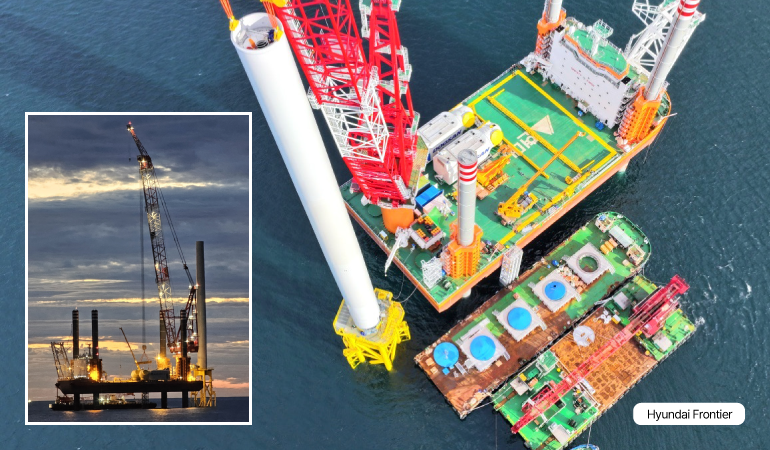
At the heart of this collaboration is the execution capability built around Korea's only dedicated offshore wind installation vessel. The offshore wind installation vessel and auxiliary equipment operated by Hyundai Engineering & Steel Industries make turbine installation and complex marine operations possible, while Hyundai E&C's sophisticated EPC management capability links every process—from design through installation—into a single coherent whole. This synergy reduces process conflicts that can arise in large-scale projects, enabling the company to simultaneously achieve both accelerated construction timeframes and quality assurance.
As the offshore wind market moves beyond the demonstration phase into commercial operation and large-scale expansion, this collaboration-based integrated infrastructure is proving to be a decisive factor in project competitiveness. The partnership between the two companies transcends a simple contractual arrangement; it is now recognized as the most powerful driving force propelling Korea's offshore wind industry into the era of large-scale development.
Part 04 Expansion
From EPC to Energy Developer:
From Sinan-Ui to the Global Market
Offshore wind has evolved into a competitive arena for comprehensive business capabilities that go far beyond design and construction to encompass development, investment, and long-term operation. Building on its accumulated construction expertise, Hyundai E&C is accelerating its transformation from its former role as an EPC contractor into a global energy developer that takes ownership of the entire project lifecycle.
Standing at the vanguard of this transformation is Sinan-Ui Offshore Wind Farm—a mega-project that opens up new horizons for Korea's offshore wind industry. Generating a massive 390 MW, Sinan-Ui dwarfs the existing Jeju Hallim commercial-scale wind farm (100 MW) by nearly four times. Hyundai E&C will participate in every phase of this massive endeavor: project planning, project financing, construction, and over 20 years of subsequent operation. This will serve as the stage upon which Hyundai E&C demonstrates its unrivaled business capabilities—not merely erecting turbines at sea but developing and managing energy assets worth trillions of won.
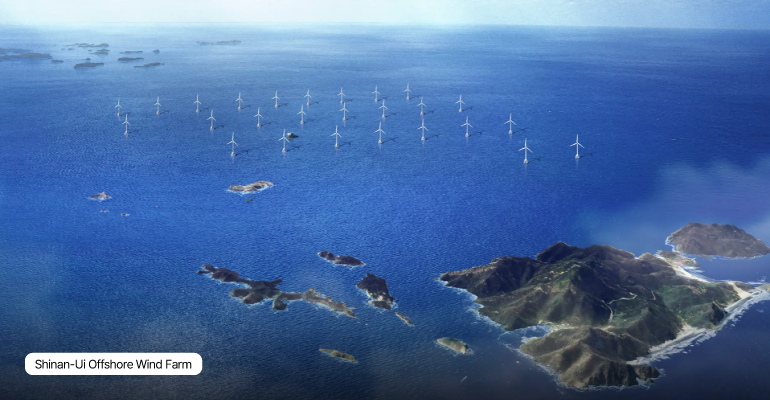
This evolution reflects Hyundai E&C's firm resolve to treat offshore wind not as a one-off construction project, but as a sustainably managed 'energy asset' that generates long-term value. The construction optimization solutions and business models perfected at Sinan-Ui will serve as the strongest possible calling card for future entry into global markets.
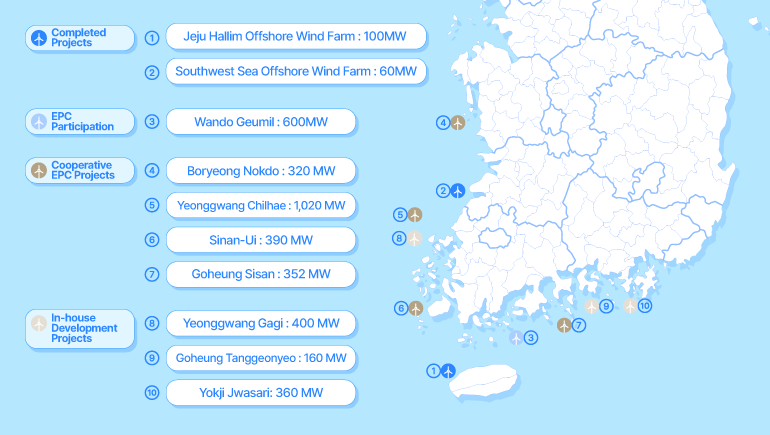
Armed with proven construction capabilities and unrivaled dedicated infrastructure, Hyundai E&C is now ready to activate a massive pipeline totaling 5.6 GW in cumulative capacity—valued at KRW 12 trillion. The development leadership demonstrated at Sinan-Ui will serve as a powerful milestone, helping to establish a novel Hyundai E&C ‘energy domain’ not only across Korea, but on the high seas around the world.
Join Hyundai E&C newsletter.
Hyundai E&C Newsletter
Meet the various stories from Hyundai E&C Newsletter every month.
Subscribe to Hyundai E&C newsletter and get the latest news via e-mail.
- Name
-
-
@
- Part
-
- country
-
Privacy Policy
We may collect the personal information for the following purposes.
- Information
- Name, E-mail, and Part
- Subject
- Apply and Discribe for the Newsletter, Deliver Newsletter
- Period
- Your personal information will deleted in 5days of work day.
- Name
-
-
@

Registration Number 101-81-16293, 03058 Hyundai Bldg., 75, Yulgok-ro, Jongno-gu, Seoul
© HYUNDAI E&C. ALL RIGHTS RESERVED.