

Latest News
- Hyundai E&C Expands Footprint in Global Housing Development Market
- Hyundai E&C to Complete Korea's First AI Data Center in 16 Months
- Hyundai E&C, Seoul National University Hospital, and Seoul National University Jointly Develop AI-Based Next-Generation Healthcare Residential Services
- Hyundai E&C Sets Out to Secure Core Technology for Next-Generation Hydrogen Production via Water Electrolysis
- Hyundai E&C to Build a Future Mobility Safety Framework for Residential Complexes
[2026 Mega-Trends × Hyundai E&C] Five Keywords Breaking Through Uncertainty
![[2026 Mega-Trends × Hyundai E&C] Five Keywords Breaking Through Uncertainty](/FileContents/EditorImg/20260224/12.png "2026 Mega-Trends × Hyundai E&C")
The new year of 2026 is here. Your fresh diary has just begun to fill up, you've signed up for the gym, but you're still not quite sure where the world is headed this year? You're not alone. We're all living in an age of uncertainty where 'change' has become the default setting. In 2026, the world is shifting more rapidly than ever, and in this massive vortex of transformation, individuals and corporations are facing the fundamental question: ‘How do we survive?’ That’s why we have prepared: the ‘Five Mega-Trends’ that will shape 2026. Join us for a preview of the currents that are redefining not just trends, but the very structure of industry and life itself, and see how Hyundai E&C is redefining the future of construction at the forefront of this change.
Energy is the Currency of the Future: Why Global Corporations are Entering the Energy War
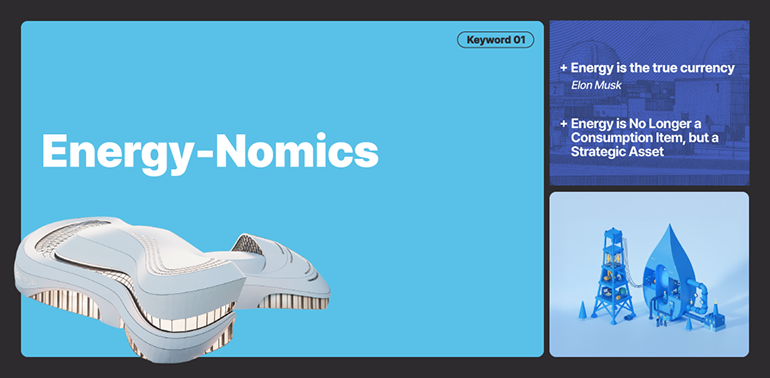
Just a few years ago, the word ‘energy’ was most tangible to people as a number on a bill. Now, the situation has turned 180 degrees. Reports from numerous institutions, including the International Energy Agency (IEA) and Korea Trade-Investment Promotion Agency (KOTRA), all emphasize that energy is no longer a simple cost, but the ‘new currency’ that will determine the survival of nations and corporations. We have moved past the era of simply asking ‘how much energy can we save?’ to an age where global dominance is decided by who can ‘secure, store, and efficiently trade’ cleaner energy.
The entities most sensitive to this shift are the global big-tech companies. To secure the massive amounts of power needed to operate their AI data centers, giants like Google, Amazon, and Microsoft are staking their survival on energy self-sufficiency—contracting directly with nuclear power plants or developing vast renewable energy complexes. This is because, as the transition to a decarbonized economy accelerates, a company's competitiveness will be determined not just by how well it makes its products, but by how stably it can generate and make use of clean energy. Ultimately, the companies that possess energy infrastructure technology to design and build massive systems of energy production and supply will hold the reins of the future economy.
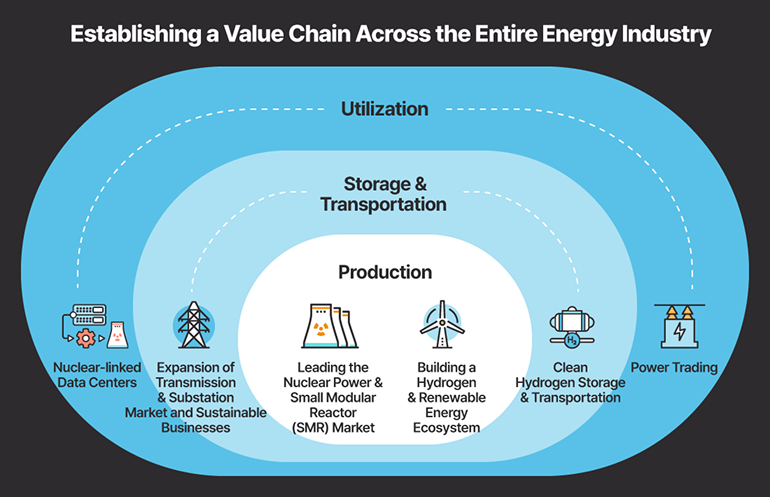
Hyundai E&C proactively read these trends and has boldly expanded the boundaries of the construction industry into the energy domain. The strength that led to the momentous achievement of KRW 25.5 trillion in annual orders last year, a first for a Korean construction company, was made possible by the support of the company’s energy transition strategy. We are accelerating our transformation into a global energy infrastructure company through our ‘Energy-nomics’ strategy—designing the production, storage, transportation, and consumption of energy not as separate processes, but as a single ecosystem.
The Final Piece of the Puzzle in Realizing Technological Precision: Human Intuition
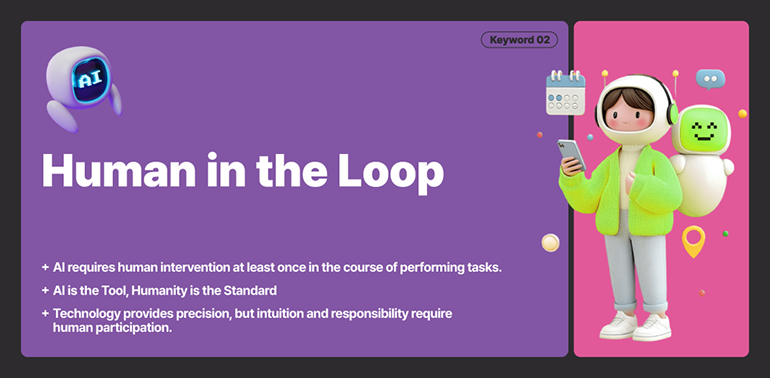
We are in an age where AI analyzes data, predicts risks, and robots roam construction sites. Yet, paradoxically, the more sophisticated technology becomes, the more critical human intervention becomes in adding the final touches to the system. This is the core philosophy of the global tech industry in 2026: ‘Human in the Loop (HIL).’
The reason for this trend's emergence is clear. Just as a human must resolve unexpected situations that an autonomous vehicle finds difficult to judge, construction, too, requires something beyond the impeccable calculations of AI. No matter how advanced, no AI system is immune to data errors or hallucinations. In fact, world-leading tech companies like OpenAI and Google consider reinforcement learning from human feedback—where humans intervene in and provide feedback on AI judgments—a core process that determines a model's completeness.
On a construction site, a 'non-standard environment' where weather conditions and terrain change daily, the know-how and intuition of a skilled technician are indispensable. Ultimately, this is an era where technology is not a replacement for humans, but a tool for augmented intelligence that extends human capabilities. The evolution of construction now depends on how closely technology and people can collaborate.
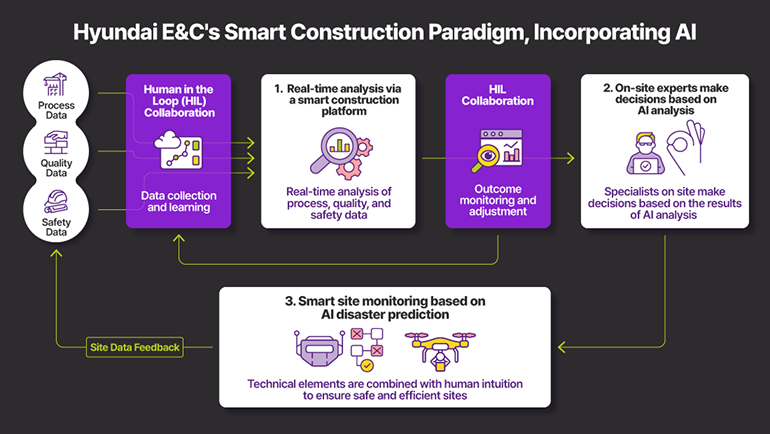
Hyundai E&C aims to lead the construction industry beyond digital transformation (DX) towards AI transformation (AX), fostering smart sites where technology and people coexist in harmony. By integrating the process, quality, and safety data from all the company’s sites for real-time decision-making, Hyundai E&C is advancing its construction technology. This goes beyond simple site monitoring to yield comprehensive results: increased productivity through resource optimization, industry-leading quality assurance through precision data analysis, and proactive safety reinforcement through AI-based disaster prediction. Over the longer term, Hyundai E&C's smart construction paradigm strives to create a virtuous cycle where data becomes the core standard for decision-making, and the results, in turn, feed back into strengthening the competitiveness of the entire construction process.
In an Age of Uncertainty, Building Foundations Anew
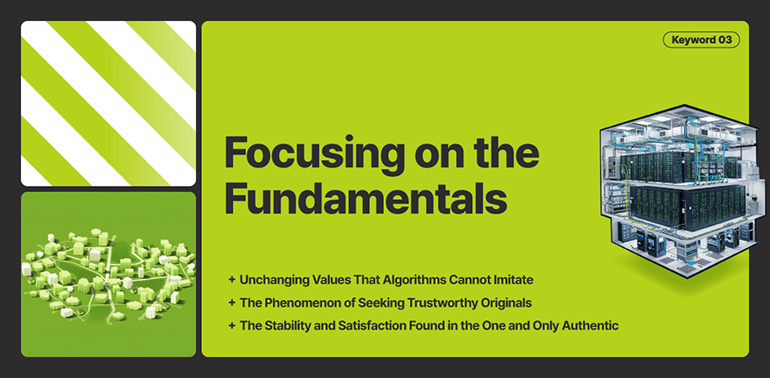
The essence of the ‘Old Money Look,’ currently trending in fashion, isn’t flashy logos. People are captivated by the overwhelming luxury and craftsmanship of the materials, which may seem plain at first glance but become more apparent upon closer inspection. This phenomenon is not limited to fashion. Trend Korea has identified ‘Focusing on the Fundamentals’ as one of the keywords that will define 2026, noting that society is once again focusing on basics and essence. Faced with unpredictable economic circumstances, a climate crisis that breaks records every year, and global resource risks, in an age where uncertainty has become the new constant, people are beginning to place a higher value on a sense of stability that protects, rather than on glamor that dazzles the eyes.
This current is clearly visible in the construction industry as well. The substantive engineering capability to solve the fundamental challenges facing humanity—such as energy depletion and the explosion of data—is itself becoming a company's most powerful brand. Construction is no longer just about erecting buildings; it is now proven by how robustly a company can build the core infrastructure that keeps the national economy running without interruption. This includes stable energy grids, cutting-edge industrial facilities, and innovative residential spaces that determine our quality of life. We have entered an era where engineering excellence that remains steady amidst changing trends—in other words, a solid foundation—has emerged as the surest asset for the future.
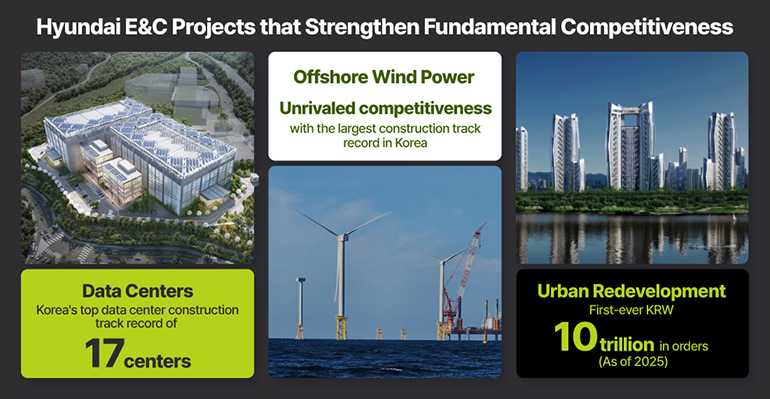
Based on 79 years of accumulated engineering capabilities, Hyundai E&C is dedicated to strengthening the essential competitiveness that maintains and extends urban vitality. This is evident in the company’s unrivaled construction record for data centers that will support the AX era, and extends to the building of energy infrastructure that will lead the carbon-neutral era, such as offshore wind power projects, where ranks first amongst Korean construction firms. In addition, a legacy of overwhelming quality and trust, which dates back to the Apgujeong Hyundai Apartment Complex project, has led to the record-breaking achievement of KRW 10 trillion in urban redevelopment construction project orders, demonstrating why Hyundai E&C has the firm footing to rise above the uncertainties of our time.
Focusing on the Emotional Experience of Space
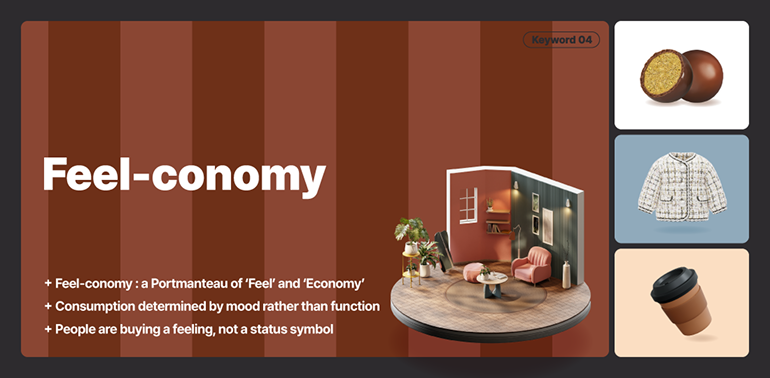
"The coffee at that café is average but the vibe is great, so I keep going back." Within this nonchalantly exchanged sentiment lies the concept of the ‘feel-conomy,’ the most powerful economic driver of the year. In a nutshell, it denotes consumption decided by feeling, not function. We are now in the era of 'feel-conomy,' where consumers willingly open their wallets not for rational functions or affordable prices necessarily, but for things that awaken their senses and provide a sense of emotional satisfaction.
Residential spaces are now evolving beyond simple places to sleep and rest into 'emotional platforms' that foster bonds with their inhabitants. While in the past, the criteria for choosing an apartment were limited to physical indicators like 'proximity to a subway station' or 'school district,' today's consumers are starting to place a premium on the emotional value a space provides them.
Indeed, the world-renowned trend analysis agency Worth Global Style Network (WGSN) identifies ‘emotion’ as a key driver of modern consumer behavior. Reflecting this, recent residential design trends are converging around keywords such as sensory-focused sanctuary, emotional resilience, and wellness-based design. This reflects the demand for spaces to provide psychological stability and emotional engagement to their inhabitants. We've entered an era where how effectively you cater to residents’ sensibilities, in addition to the solidity of the actual ‘hardware,’ determines a residential brand's true value.
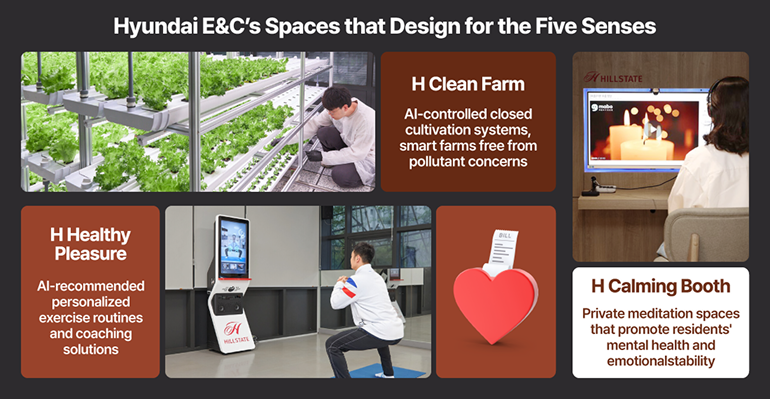
In realizing spaces imbued with sensibility, Hyundai E&C blends both engineering and art. We are not just building homes; we are creating sensory moments experienced by residents, thereby evolving into a 'lifestyle curator.'
An Era Where Your Home Cares for You: Daily Wellness Routine Completed at Home, Not the Hospital
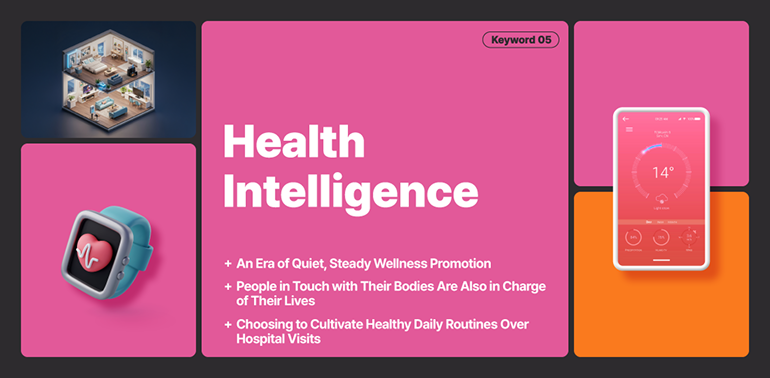
We live in an age where over 10 million people count running as a hobby. A growing number of people consider the distance they ran last night and the ‘sleep score’ recorded by their smartwatch to be more impressive status symbols than a luxury handbag. The trend of posting status updates stating “Just finished my daily workout” is juxtaposed against supporting data to open a new chapter in wellness. Health intelligence, the ability to perceive and finely tune one's physical state in real-time, and self-regulation, the practice of designing one's own routines, have become the new standards of today's lifestyle.
Naturally, the home is included in this domain. A recent insight from the Global Wellness Institute (GWI)—that the physical environment we inhabit (our home) will become the most critical foundation determining our physical and mental health—is already becoming a reality. In fact, wellness-focused real estate is exhibiting the steepest growth curve in the entire wellness economy, growing at an annual rate of 15.2%. GWI predicts this market will exceed approximately USD 1.1 trillion by 2029.
The vision of a world where homes analyze air quality to keep out fine dust pollution, adjust bedroom lighting and temperature by analyzing residents’ sleep patterns, and bathroom mirrors monitor blood pressure and overall health patterns every morning—this is no longer a distant future. Technology working intelligently behind the scenes to enhance human longevity and quality of life—this is the very image of the future home we have dreamed of and the aim of health intelligence.
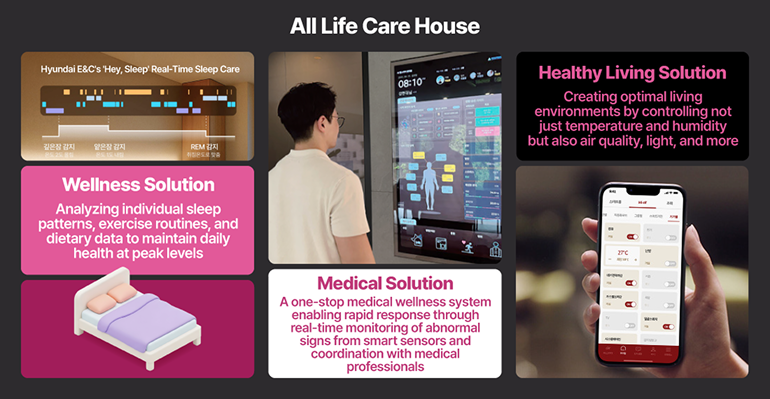
Hyundai E&C’s 'All Life Care House' is a future model that encompasses a full range of solutions—Wellness, Medical, and Healthy Living—applied to residential units and entire complexes to create a home where you become healthier. Hyundai E&C aims to provide proactive care that extends the healthy lifespan of its residents.
*Source: Trend Korea 2026 (Kim Nan-do), Global Trends Korea Will Adopt in 2026 (KOTRA), A Friendly Chat about 2026 Trends (Innocean), KAIST Future Strategy 2026 (KAIST), Life Trends 2026 (Kim Yong-sub)
Join Hyundai E&C newsletter.
Hyundai E&C Newsletter
Meet the various stories from Hyundai E&C Newsletter every month.
Subscribe to Hyundai E&C newsletter and get the latest news via e-mail.
- Name
-
-
@
- Part
-
- country
-
Privacy Policy
We may collect the personal information for the following purposes.
- Information
- Name, E-mail, and Part
- Subject
- Apply and Discribe for the Newsletter, Deliver Newsletter
- Period
- Your personal information will deleted in 5days of work day.
- Name
-
-
@

Registration Number 101-81-16293, 03058 Hyundai Bldg., 75, Yulgok-ro, Jongno-gu, Seoul
© HYUNDAI E&C. ALL RIGHTS RESERVED.