

Latest News
- Hyundai E&C Expands Footprint in Global Housing Development Market
- Hyundai E&C to Complete Korea's First AI Data Center in 16 Months
- Hyundai E&C, Seoul National University Hospital, and Seoul National University Jointly Develop AI-Based Next-Generation Healthcare Residential Services
- Hyundai E&C Sets Out to Secure Core Technology for Next-Generation Hydrogen Production via Water Electrolysis
- Hyundai E&C to Build a Future Mobility Safety Framework for Residential Complexes
[QUIZ] Silhouettes of Landmarks: Can You Spot Hyundai E&C?
There are certain places so famous that a mere silhouette is enough to identify them instantly. These structures, leaving a powerful impression through their form alone, are the quintessential masterpieces crafted by Hyundai E&C. How well do you know the landmarks that define Hyundai E&C’s legacy?
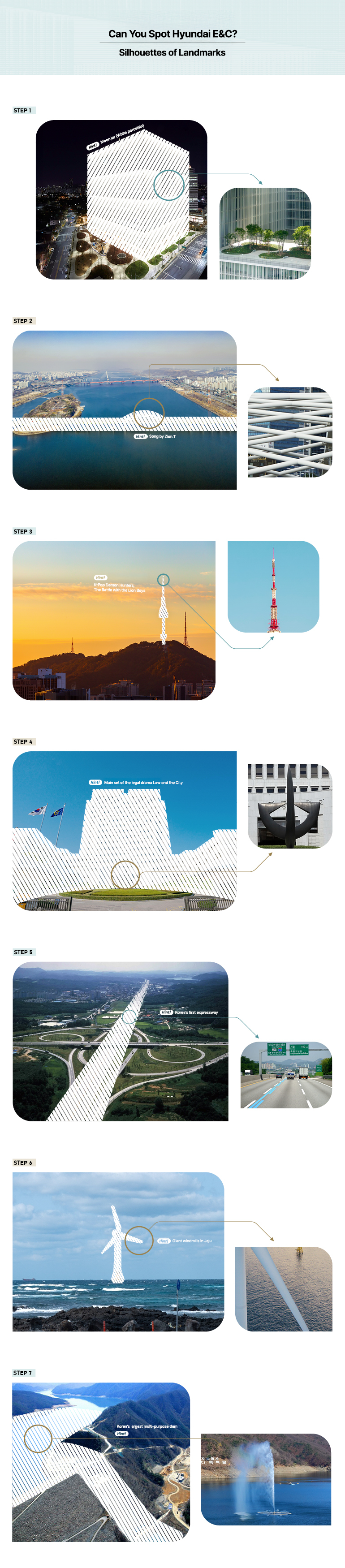 👉 Check the answers below
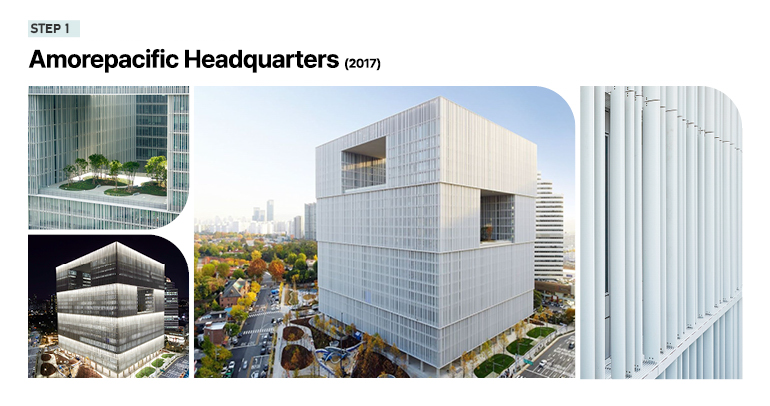
Designed by world-renowned architect David Chipperfield with inspiration drawn from the elegant curves of a traditional white porcelain moon jar, the Amorepacific Headquarters became a new symbol of the Yongsan district immediately upon its unveiling. Hyundai E&C completed this masterpiece in just 38 months. The building features massive "openings" on the 5th, 11th, and 17th floors, transformed into lush roof gardens. These spaces create a landscape that feels as though a forest has been brought inside, serving as a modern reinterpretation of the traditional Korean hanok courtyard. This unique architectural beauty was recognized globally, winning the Award of Excellence in the Cultural and Urban Landscape category at the 2019 International Federation of Landscape Architects (IFLA) Awards.
Highlight Exterior and Natural Light
The fluid exterior, where the boundary between wall and window seems to dissolve, was achieved through 21,511 aluminum fins. These fins, arranged irregularly according to floor height, effectively modulate sunlight, delivering approximately 75% of natural light into the building even on cloudy days. This ensures a bright and pleasant indoor environment year-round.
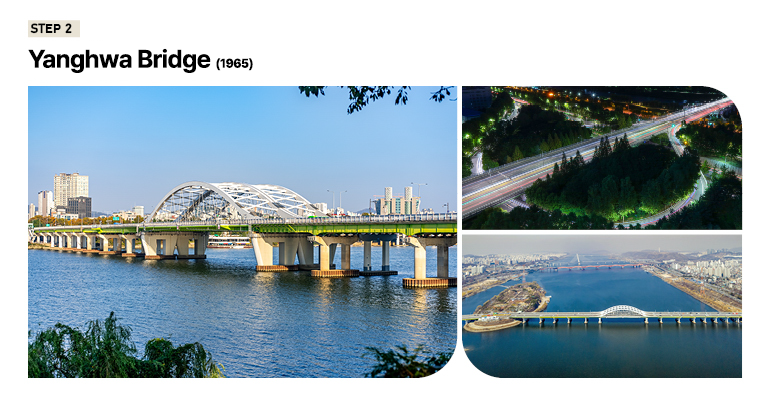
Made famous by the hit song of the same name released by artist Zion.T, Yanghwa Bridge was completed by Hyundai E&C in just two years and eight months, originally opening in January 1965 as the "Second Han River Bridge." It holds the distinction of being the first Han River bridge designed and constructed entirely with domestic technology. It was later renamed "Yanghwa Bridge" in 1984.
Highlight The First Han River Bridge Built with Korean Technology
As the second Han River bridge completed by Hyundai E&C, Yanghwa Bridge was constructed as a girder bridge, where vertical piers support the horizontal deck. With a length of 1,108 meters and a width of 18 meters, it was the largest bridge construction project of its time.
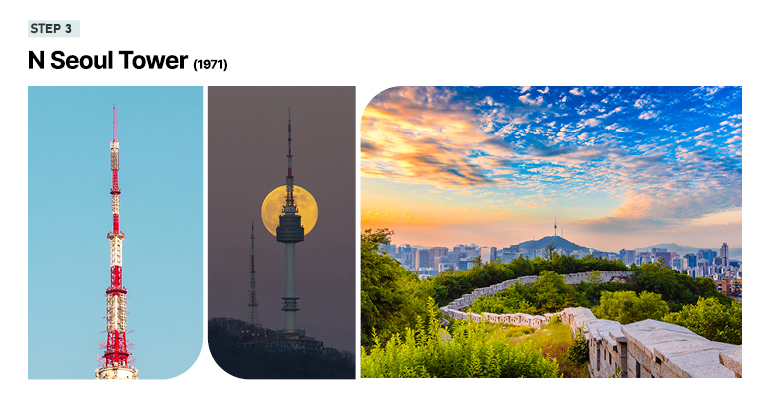
Featured in the hit Netflix series K-Pop Demon Hunters, N Seoul Tower is a symbol of Seoul that has captivated audiences worldwide. Completed by Hyundai E&C in 1971, the tower boasted a height of 237 meters—the tallest in Asia at the time. From the summit, visitors can look down upon the cityscape of Seoul from an elevation of nearly 500 meters.
Highlight The Silhouette that Defines Seoul
N Seoul Tower consists of five main components: the 5-story main building, the two-story plaza, the concrete tower shaft (the core central structure), as well as the observation deck and the steel spire that wraps around the tower. While typical tower structures often feature a long central shaft and a shorter spire, N Seoul Tower’s observation deck and antenna structure span 101 meters, accounting for nearly half of its total height. Thanks to this distinctive and sophisticated silhouette, N Seoul Tower remains a beloved landmark representing the Seoul skyline to this day.
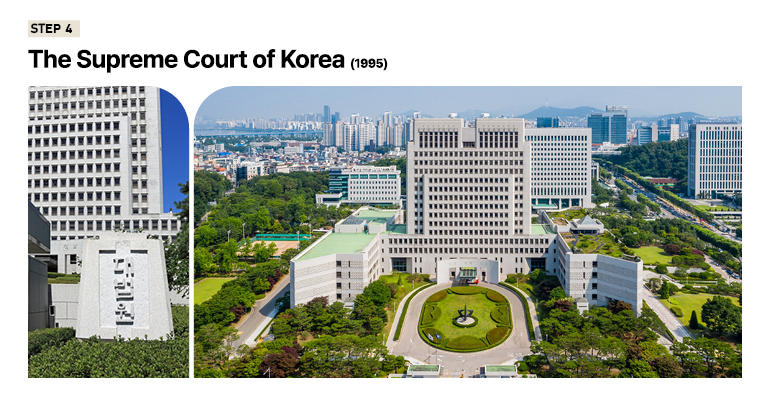
A frequent filming location for dramas such as Law and the City and Beyond the Bar, this imposing structure is none other than The Supreme Court of Korea. Beyond the Supreme Court (1995), Hyundai E&C has led the domestic construction industry by building other key national institutions that symbolize the separation of powers in South Korea, including the National Assembly Building (1975) and The Blue House (Cheong Wa Dae, 1991).
Highlight A Government Complex Embodying the Symbolism of Law
The Supreme Court of Korea features a bilateral symmetry in its lower structure, inspired by traditional palace layouts. This balanced expansion to both sides symbolizes the equity and fairness of the law. The central high-rise section commands the authority and status of the highest organ protecting the law. Finished with stone both inside and out, the building evokes a stately and sturdy image of the judiciary. Its symbolic significance was recognized when it won the Korean Architecture Award in 1996.
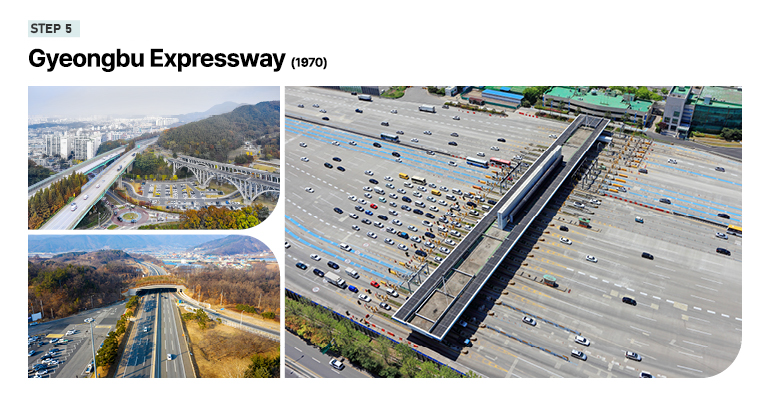
The first expressway built in Korea, the Gyeongbu Expressway connects Seoul and Busan. It fostered logistics innovation and balanced regional development, serving as the catalyst for Korea to develop world-class infrastructure.
Highlight The Birth of Korea's First Expressway
Hyundai E&C was responsible for a total of 128 km of the original highway, including the pilot section between Seoul and Suwon. At the time, this achievement was accomplished without foreign technical or financial assistance, relying solely on Korean technology and financing, instilling a great sense of pride in the public.
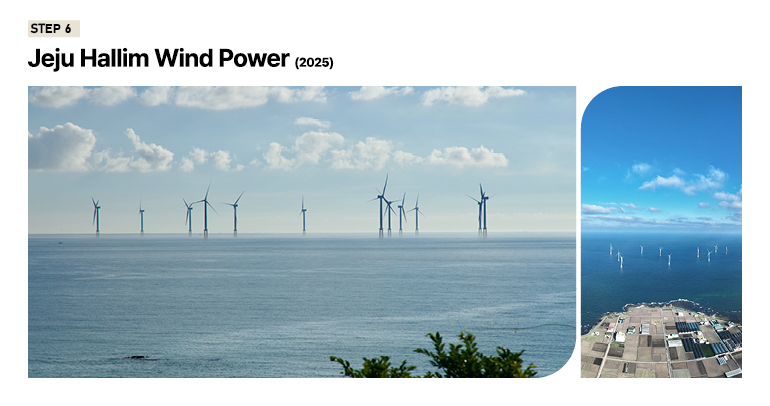
In the waters near Suwon-ri, Hallim-eup, Jeju, a massive offshore wind farm unfolds. Established as the largest of its kind in Korea, this complex features 18 generators, each producing 5.56 MW of power, expected to generate approximately 235 GWh of electricity annually. This is enough to power about 65,000 households (based on a family of four) for a year.
Highlight Overwhelming Scale and Technology
The individual offshore wind generators also boast an impressive scale. The total height of the structure, including the lower jacket and piles, rivals that of Seoul’s 63 Building (250 meters). Each blade weighs 30 tons and measures 70 meters in length, comparable to the wingspan of a large aircraft like the Boeing 777. Combining ultra-large equipment with cutting-edge construction methods, this complex has set a new standard for offshore wind power in Korea.
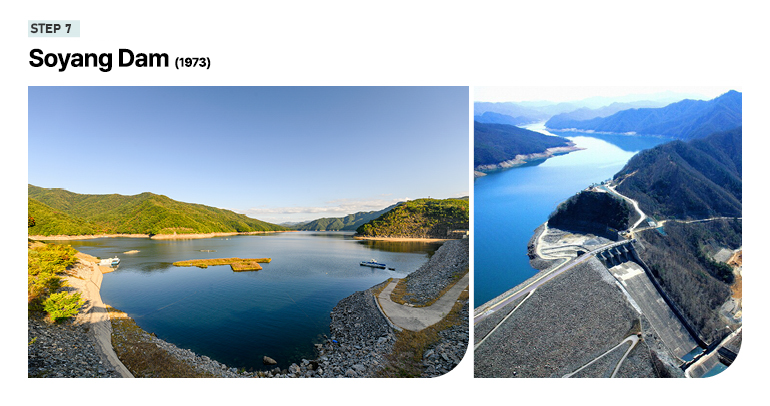
A leading tourist attraction in Chuncheon and the third dam constructed in Korea, Soyang Dam is the country's largest multi-purpose dam, standing 123 meters high and 530 meters long. Its total reservoir capacity is approximately 2.9 billion tons, enough to fill 1.16 million international-standard swimming pools.
Highlight The Largest Multi-Purpose Dam in Korea
At the time of its completion, Soyang Dam drew attention as the largest rock-fill dam in Asia. Considering the weak bedrock conditions of the site, Hyundai E&C applied a rock-fill construction method, which involves piling soil, sand, gravel, and rock, and finishing with concrete. This approach has been praised for having achieved both economic viability and construction efficiency.
Join Hyundai E&C newsletter.
Hyundai E&C Newsletter
Meet the various stories from Hyundai E&C Newsletter every month.
Subscribe to Hyundai E&C newsletter and get the latest news via e-mail.
- Name
-
-
@
- Part
-
- country
-
Privacy Policy
We may collect the personal information for the following purposes.
- Information
- Name, E-mail, and Part
- Subject
- Apply and Discribe for the Newsletter, Deliver Newsletter
- Period
- Your personal information will deleted in 5days of work day.
- Name
-
-
@

Registration Number 101-81-16293, 03058 Hyundai Bldg., 75, Yulgok-ro, Jongno-gu, Seoul
© HYUNDAI E&C. ALL RIGHTS RESERVED.